
 +1 (207) 809‑0335
 Provider consolidation slammed in latest House affordability hearing
The head of the American Hospital Association attempted to defend consolidation. Members of a House Energy and Commerce subcommittee were unmoved.
Article By: Rebecca Pifer Parduhn
Blog Source From : https://www.healthcaredive.com/
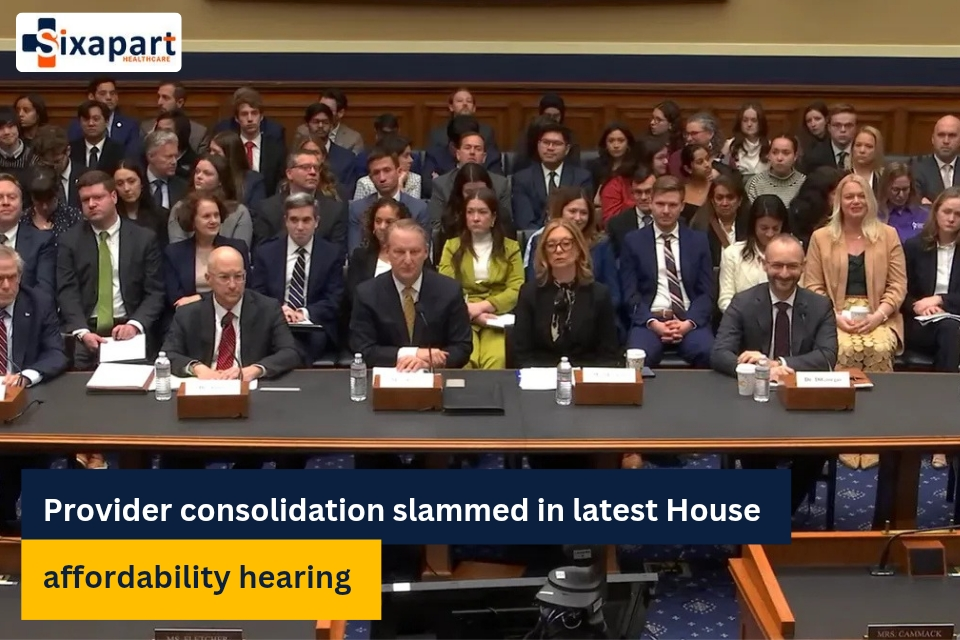
Healthcare DiveSign upmenuProvider consolidation slammed in latest House affordability hearingThe head of the American Hospital Association attempted to defend consolidation. Members of a House Energy and Commerce subcommittee were unmoved.Published March 19, 2026Rebecca Pifer Parduhn’s headshotRebecca Pifer ParduhnSenior ReporterShare this articleShareLicense this articleLicenseSet preferred sourceAdd us on GoogleWitnesses testify during a House E&C Health subcommittee hearing.Witnesses testify in front of the House Energy and Commerce’s Subcommittee on Health during a hearing on the U.S. provider landscape on March 18, 2026, in Washington, D.C. Rebecca Pifer Parduhn/Healthcare DiveListen to the article7 minCongress is continuing to take aim at rampant healthcare consolidation — this time among providers, forcing a major hospital lobby to defend how health systems are snapping up smaller hospitals and doctor’s offices in front of the House Energy and Commerce’s Health subcommittee.Hospital and physician associations are the latest to be dragged to the Hill as the House Republicans hold a series of hearings on healthcare affordability. Health insurance and pharmaceutical representatives testified in January and February.
On Wednesday, it was providers’ turn, with top executives for the American Hospital Association, American Medical Association and the American Academy of Family Physicians joined by the head of a major purchaser lobby, a neurosurgeon and a community care advocate in the hot seat.The temperature during the hearing was noticeably lower than it was for insurers, with lawmakers reiterating the importance of the U.S. provider infrastructure and asking how Congress can ensure stability for hospitals and doctors.During their testimony, provider groups outlined the challenges they’re facing, such as the increasing cost of staff and medical supplies, a worsening shortage of medical workers and inadequate reimbursement from insurers, especially Medicare and Medicaid, that’s only expected to worsen if Congress doesn’t act.Still, providers themselves are not blameless, other witnesses and lawmakers said.Overall, spending on hospitals and providers represents more than half of the nation’s entire healthcare spending, and is growing at a faster rate than healthcare spending overall, according to government data. Regulators and market experts are particularly concerned about how mergers and acquisitions among providers could be driving spending up, an issue that’s been gaining steam in Congress.Along with large health systems purchasing regional hospitals, hospitals are also acquiring doctor’s offices at a fast rate, and prices are rising as a result with no improvement in quality, research suggests.
Rick Pollack, the president and CEO of the AHA, attempted to defend consolidation on Wednesday, noting some doctors want to be acquired by hospitals to have a partner handle administrative tasks, and some rural hospitals choose to be acquired to remain in business.Moreover, operating costs lower while readmission and mortality metrics improve when systems come together, Pollack said.Lawmakers appeared unmoved by his arguments.“I think the data points to a completely opposite scenario than what you just painted,” said Rep. Kat Cammack, R-Fla.Lawmakers took aim at prominent drivers of consolidation, such as hospitals’ desire to expand savings from the 340B drug discount program, which Rep. Buddy Carter, R-Ga., called a “big, big problem.”Hospitals are also incentivized to acquire outpatient departments because they can charge Medicare more if a service is provided at a hospital-owned site than a non-hospital-owned facility is allowed to charge. That’s an example of unjustifiable price differences between settings, and one that could save Medicare billions of dollars if addressed, testified Elizabeth Mitchell, the president and CEO of the Purchaser Business Group on Health, which represents large employers“A band-aid is a band-aid. A CT scan is a CT scan. And yet they are upcharging because they can,” she said.Lawmakers were also upset about confusing and unexpectedly high hospital bills. House Energy and Commerce Chair Brett Guthrie, R-Ky., shared a story of his wife being billed $28,000 by an unnamed hospital for a 6-hour stay to treat a kidney stone.In another instance, a hospital referred him and his wife to a debt collector after she needed emergency care for a broken arm, because it was unable to log her insurance information while she was receiving treatment.“The provider, who could have called us because they obviously knew who we were, because they turned us in to a debt collector, didn’t even reach out. Fortunately, not many of my constituents can do this, I have the CEO’s cell number,” Guthrie said. Still, because they were referred to a debt collector, “now [the bill] is double, triple — three times what it originally was.”Hospital pricing is “utterly irrational,” Mitchell agreed. “It is not related to quality, it is not related to safety, it’s basically whatever a hospital can charge and get away with.”Witnesses testified that Congress could crack down on hospitals to increase compliance with price transparency regulations, while bolstering the financial health of U.S. doctors so it’s easier to fend off any acquirers that come knocking.Burdensome administrative requirements, deficient reimbursement and rising expenses have made it almost impossible for doctors to remain independent, testified Anthony DiGiorgio, a neurosurgeon with University of California San Francisco Health, on Wednesday.Just over 42% of physicians worked in private practices in 2024, compared to more than 60% in 2012, according to the AMA. More than one-third of U.S. doctors work for hospitals.“The system essentially starves independent practices of revenue while burying them in paperwork, making selling to the hospital the only way out,” DiGiorgio testified.
We need a thriving independent physician sector. If Congress continues to kick the can down the road or rely only on band aids, the U.S. health system will continue consolidating into a top-down market dominated by a handful of vertically and horizontally integrated monopolies — and the American patient will be the one paying the price,” he said.AMA Chair David Aizuss and R. Shawn Martin, the CEO of the AAFP, urged Congress to reform how Medicare pays physicians so that annual reimbursement hikes can more adequately match rising costs.Physician groups have long lobbied Medicare to increase doctors’ pay based on a measure of inflation, while removing a requirement that updates to their reimbursement schedule be budget neutral.DiGiorgio also asked Congress to consider allowing more physician-owned hospitals, which are currently prohibited under the Affordable Care Act, and reforming the Stark Law, which prevents physicians from referring patients based on their financial interests, arguing that the policies suppress market competition and put higher standards on independent doctors than on corporations.During the hearing, Democrats took aim at Trump administration policies that they argued will make it harder for new doctors and nurses to enter the workforce, amid rising concern about the growing scarcity of medical workers.The Association of American Medical Colleges projects that the U.S. will face a shortage of up to 86,000 doctors within the next 10 years.Yet the Trump administration instituted a steep $100,000 fee on H1B visas — “the visas that many healthcare workers rely on,” said Rep. Lizzie Fletcher, D-Texas — and capped how much a medical student can borrow from the government, a policy that Rep. Marc Veasey, D-Texas, called “devastating” to the nation’s pipeline of doctors.Democrats also took the opportunity to slam Republicans for the major cuts to Medicaid in the “Big Beautiful Bill” passed last summer and the GOP for allowing more generous financial support for Affordable Care Act plans to expire at the end of last year.Republicans argue the policies will increase the integrity of federal healthcare programs. But millions of Americans are expected to lose insurance as a result, causing U.S. providers to lose hundreds of billions of dollars in revenue while absorbing significantly higher levels of uncompensated care.“This is very rich. The majority is calling a hearing on the high cost of healthcare while flat out denying the elephant in the room. This is a problem exacerbated by their making,” said Rep. Raul Ruiz, D-Calif.